Lets Get Snapping!
- Emily Stump

- Apr 30, 2018
- 4 min read
Here's a really boring definition of photography brought to you by Wikipedia:
Whaaa?? ...
There are a few old things that will always remain a mystery to me. Like the Internet. The internet is like another dimension -or a galaxy that is up close and personal. I also don't understand televisions. And phones. Phones from long ago and phones from today. Heck, I really don't even understand telegrams. And if we go from the inert to the living and breathing, it really psychs me out when I think that my heart beats for some other reason than my own cognitive direction. And don't get me started on digestion .... how can something that I do, work without me understanding how I do it? And while I am asleep to boot.
So it is with xrays, MRIs, CT scans, ultrasound, and photography. And I've "studied" all of them. I've seen all of them, and work with several. And I still don't really get it completely.
But I can take a pretty decent picture and take a decent xray image, despite all that I don't yet know about them. It can be a complex topic, this study of light and how to find it, manipulate it, and record it. And there is so much gear that one can tumble into debt over if she's not careful (how we photographers salivate over gear...). You don't need to have the best gear or a lot of gear though. You just need to know how to work with what you have, to understand light and shadows, and how to capture them in the way that you want to capture them. Then build from there. I'm always learning, always trying to practice, and I'm becoming less and less afraid of making mistakes because I'm realizing that I learn the most through them.
Anyway, I thought I'd finish out this little photo-documenting series with the last two topics: {Light and shadows} and {Framing, Layering, and Focusing}. Its going be really simple because I'm pretty simple.


Light can really crap out an image. So can shadows. A sensor will have a hard time finding focus on something if the camera isn't set right. Understanding aperture, shutter speed, and ISO is vital if you want to take more creative control of your images. I won't get into those. I just want to simply encourage you to not be afraid of either. Light and dark can really set the vibe of a picture. I tend to shoot in the evening's golden hour with my clients and I always try to do something creative with the sun. But it wouldn't be as impactful if it wasn't for the balance of dark . Sometimes I underexpose on purpose (make the image darker). Sometimes I over expose (blow out the highlights like in this picture taken at Pheasant Run Greenhouse).

I used to be afraid of shooting with limited light. I thought that my camera's sensitivity to light was limited before creating a lot of "noise" in an image. I am reevaluating that belief and trying to learn how far my camera can go and with what parameters. This picture with my daughter's feet and Tiny is special to me because of the story behind it. Last year was the first year in our new house and in the new school district. It became a habit of Noel's in the mornings, to sit with her back against the wall, waiting for 6:54. This dark image brings back memories and feelings - mostly worry and anxiety over my kids. It holds a lot of meaning for me. And not one kid face is in it, lol! {ps, that box in the background? That held my Christmas gift which was Travis my Three Legged Tripod - speaking of saliva inducing gear} Light and shadows create mood. Go find that light!
Framing (capturing your subject between objects to highlight it), layering (capturing more than one story in an image which may or may not pertain to each other), and focusing (making something sharp while other objects in the picture are more out of focus) are each techniques that take practice. These are things that I am trying to improve on, especially layering, which requires the shooter to be aware of everything that is going on around her (which is hard for me because I tend to really focus on what I'm capturing at the moment).


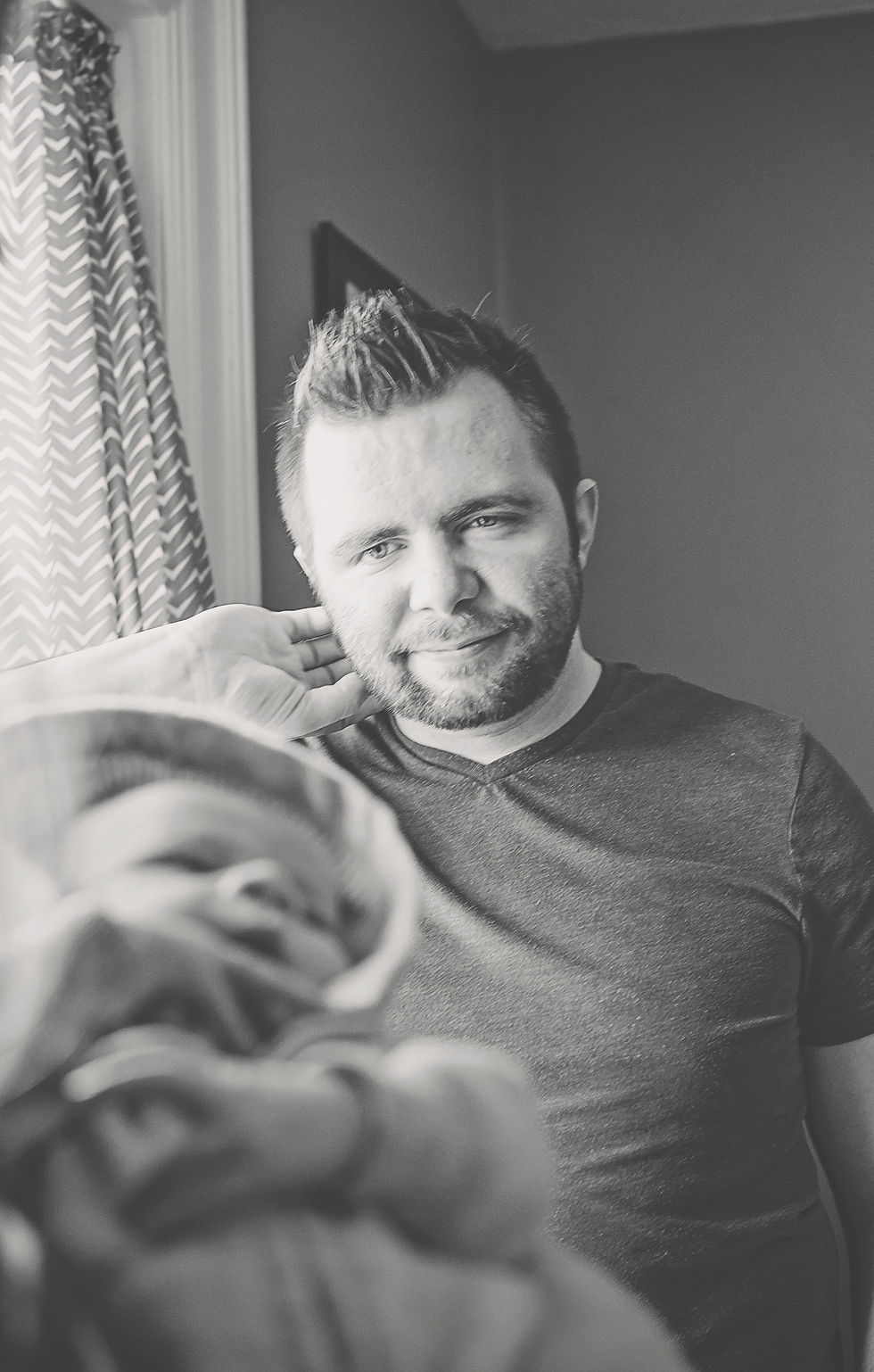
Focus on one thing and it tells a different story than if you took the same shot but put your focus on something else. This baby picture is more about his daddy than baby Zeek. If I switched up the focus, it would tell a different story. Or at least the same story from a different perspective :) Here's Zeek a year later, a mover and a shaker, being framed by an Adirondack chair that moments earlier, he had been climbing on. His face is the main feature because it is heavily framed. The technique of layering is harder for me and I don't really have many examples yet. But practice makes better and so I will learn to look for the story behind the story. In this picture, my sista found a doll hidden behind some mirrors while we were antique shopping. One story is about the evil baby behind the mirror, another other story is about my horrified friend, as evidenced by her facial expression, and another is about the annoying paparazzi photographer who claims to be photo-documenting. These stories intertwine. I'm pushing things a bit I think in claiming that this is layering. I have a picture of another friend taken in Nashville (I won't post this one but try to imagine it). He's off to the right side of the picture, all alone while seated on a bicycle, looking (sadly) down at his phone. Off to the left side of the picture is this huge trolley like contraption with maybe a party of 10 people pedaling it around, having a blast while touring Broadway. Two different stories, one picture.
There you have it! I know what I need to practice, what are you going to work on?


Comments